User Experience Design for complex websites & web applications. Take the red pill.
Back

User Experience Strategy

“The only thing more expensive than writing software is writing bad software.” – Allan Cooper

Insights from user research are valuable only if they are socialized within the organization and applied throughout requirements gathering and design.  Gaining stakeholder buy-in early eliminates many of the problems caused by  ”design by committee.”

Many tools (some borrowed from user research) exist for involving stakeholders in the process of requirements gathering and prioritization: one-on-one interviews, personas, affinity diagramming, rich pictures, and structured brainstorming.   Together with lessons from user research, these tools can be used to develop a coherent UX strategy within the organization.


User Research and Evaluation

User Research Sticky Notes “In my opinion, no single design is apt to be optimal for everyone.”
- Don Norman

Designing a new website or application is a leap into the unknown – business realities are always uncertain. Under pressure, decision-making is difficult, and (many) conflicting opinions are the norm. User-centered design aims to reduce uncertainty by validating concepts early and often with users who are truly representative of the target audience.

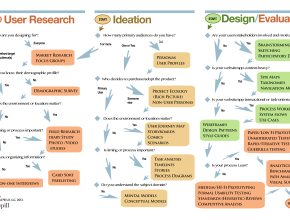
Many techniques exist for gathering user feedback throughout the design process: interviews, surveys, requirements prioritization exercises, card sorting, usability testing, and many others. Involving users throughout the process allows the team to develop an optimal solution with greatest likelihood of user adoption.


Interaction Design and Information Architecture

“You can use an eraser on the drafting table or a sledge hammer on the construction site.” – Frank Lloyd Wright

User-centered design puts the task of satisfying user goals before visual design. For content-heavy websites, information architecture, or organizing the content effectively, is time well-spent. For web applications, interaction design, or the behavior of the application, becomes paramount.

Incorporating an interaction design phase into the process can serve as a sandbox for the design team to evaluate various approaches and understand the full scope of the project before the first line of code is ever written. The deliverables are sketches, wireframes, site maps, process diagrams, prototypes, and specs: blueprints to be used by engineers to guide development.


Forward